Julia Child’s Boeuf Bourguignon

Happy, Happy Birthday Julia!!! It is her 100th birthday today!!! This is what we have been celebrating for 15 weeks now. What a fabulous adventure this has been for us. I have breathlessly awaited each recipe with anticipation!! Then researched, watched my Julia DVDs, chopped and sauteed, baked and cooked Julia’s wonderful recipes for all these weeks. An experience I will treasure for the rest of my life. An ode to a fabulous lady who thought outside the box and brought this side of the world out of frozen dinners and canned products. Back to where we should always be and that is cooking with fresh locally grown produce.

I would also like to thank Alfred A. Knopf Publishing for all their support and sharing of my photos. Not always the best as I am still learning. Also I would like to thank Colbern Uhl and YC Media for giving me this chance to share in something so fabulous. I am very grateful to have been chosen to participate.

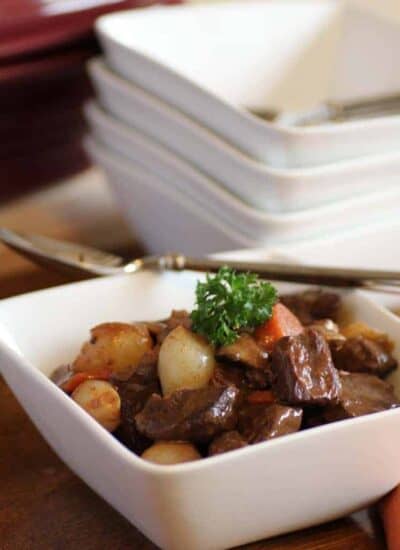
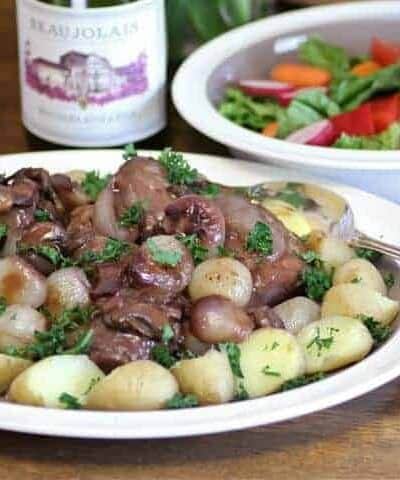
Today’s recipe is one that I have done so many times, either Julia’s recipe or Ina Garten’s. It is a grand beef stew fit for a king or just our little family on a Tuesday night!! I watched Julia as I have tried to always do prior to making the recipe. She did a much simplified version than what the written recipe is. No bacon, no carrots or sliced onion. I improvised between these two recipes and made a fabulous Bourguignon. Thank you Julia from the bottom of my heart!!!

Julia Child’s Boeuf Bourguignon
Author: 
Prep time: 
Cook time: 
Total time: 

Serves: 6
 

A fabulously rich beef stew!!
Ingredients
  • 6 oz. of bacon, cut into lardons
  • 1 Tbsp. olive oil
  • 3 lbs. lean stewing beef
  • 2 sliced carrots
  • 1 sliced onion
  • 1 tsp. salt
  • ¼ tsp. pepper
  • 2 Tbsp. flour
  • 21/2-3 cups red wine, such as a Burgundy, Cotes du Rhone or Beaujolais
  • 2-3 cups beef stock
  • 1 Tbsp. tomato paste
  • 2 cloves garlic, smashed
  • ½ tsp. thyme
  • 1 bay leaf
  • 1 lb. pearl onions
  • 1 lb. fresh mushroom caps, quartered
  • 1 Tbsp. olive oil
  • 4 Tbsp. butter, divided
  • 2 Tbsp. flour
  • Parsley for garnish

Instructions
  1. Saute the bacon in a large saute pan in the 1 Tbsp olive oil over medium low heat until it is lightly browned. Don’t let it get crisp. Remove to a paper toweled lined dish.
  2. Dry the beef with paper towels. Bring the pan up to medium high and just before the oil is smoking add the beef in small batches and brown in the hot oil. Brown it on all sides. Remove to a casserole dish. Preheat oven to 325F.
  3. In the same pan brown the carrots and onions. Add them to the casserole dish along with the beef. Toss the meat and vegetables with the salt, pepper and flour. Mix the tomato paste with half cup of the wine so that it will easily mix in. Pour that onto the meat mixture followed by the rest of the wine, garlic and herbs. Top off the casserole now with beef broth and add in enough just to cover the beef. Add the bacon. Place in the oven and let simmer slowly for 2½-3 hours.
  4. While the stew is cooking prepare the mushrooms and onions. Take the onions and cut a small x into the bottom of each onion. Bring a large pot of water to the boil and place onions in for 20-30 seconds. Remove and rinse in cold water to cool. Cut the small root end off and carefully peel the onions. Set aside.
  5. For the mushrooms add the 1 Tbsp. olive oil and 2 Tbsp. butter to a large fry pan and heat on high. When the butter foam starts to subside add the mushrooms. Toss and shake the pan for 4-5 min. During this time the mushrooms will first absorb the fat and after a few minutes it will reappear. Cook until lightly browned and then remove from heat.
  6. When the meat is done, take it from the oven and skim off the fat and pour the contents through a sieve over a saucepan. You should have about 2½ cups of liquid, if you have more boil it down rapidly, if you have less add some beef broth. Bring the sauce up to a simmer. Mix the flour and butter together to form a paste. Remove the pan from the heat and add the paste whisking to incorporate. Return the pan to the heat and add the pearl onions. Cook for 15-20 or alternatively have the onions cooked in water for the same time. Stir occasionally until the sauce is thick. Adjust seasoning with salt and pepper.
  7. Add the mushrooms to the meat mixture in a clean casserole if desired. Pour the onions and sauce over. Serve in individual bowls garnished with chopped parsley.

Mastering the Art of French Cooking by Julia Child. Copyright © 1961 by Alfred A. Knopf. Reprinted with permission from the publisher Alfred A. Knopf, a division of Random House, Inc.

Print Friendly

Julia Child’s Scallops Gratineed

Another week has gone by and we are in week 14 of our celebration. August 15 Julia’s 100th birthday!!! One more week to go and scallops are on the plate today. I am a huge lover of seafood but scallops have to be one of my least favourites. For me it has always been the texture. It goes back to my days of not really liking fish. It is all in the preparation of the scallops that makes it or breaks it and I have had some really bad scallops that were rubbery. Julia comes to save the day again. I would have these scallops again in a second. Rich and flavourful with no issues of texture. They were sliced thinly and cooked rapidly which I have never seen before. Ken and Amber both love scallops so they just gobbled them down with barely a word spoken. They loved them!! And so did I, amazing!!! I am not sure about the taboo of no cheese with seafood or where that came from but now we have had two weeks of seafood and cheese together. Last week being the lobster cheese souffle. So I am throwing that out the window. Anyway grab some little shells from your local kitchen store and whip up these lovelies for your family or friends soon. They are a great make ahead also, which I love. They just need to be run under the broiler at the last minute before serving. Love ya, Julia!!!

1/3 cup minced yellow onion
1 Tbsp. butter
1 1/2 Tbsp. minced shallot
1 clove garlic minced
1 lb. washed scallops
salt and pepper
1 cup flour
2 Tbsp. butter
1 Tbsp. olive oil
2/3 cup white wine
1/2 bay leaf
1/8 tsp. thyme
1/3 cup grated Gruyere cheese
1 Tbsp. butter
6 buttered scallop shells

Cook the onion in a large saute pan in the butter very slowly for 5 min. Add the shallots and garlic and cook for another 1-2 min. Do not brown. Remove from the pan and set aside.

Dry the scallops and cut them into 1/4″ slices. Heat the butter and olive oil on high in the saute pan until very hot but not burning. Just before adding the scallops toss them into the flour and season with salt and pepper. Shaking off excess flour. Saute the scallops very quickly in the butter until lightly browned, about 2 min.

Pour the wine, herbs and onion mixture into the pan and cover and cook for 5 min. Then uncover and boil down the sauce if necessary to thicken. Adjust seasoning and remove bay leaf.

Spoon the scallops into the prepared shells and top with the cheese. Divide the Tbsp. of butter amongst the shells, dotting on top. You may refrigerate them at this time until ready to serve.

Just before serving run them under a moderately hot broiler for 3-4 min. to lightly brown the cheese.


Excerpted from Excerpted from Mastering the Art of French Cooking by Julia Child. Copyright © 1961 by Alfred A. Knopf. Reprinted with permission from the publisher Alfred A. Knopf, a division of Random House, Inc.


Print Friendly

Julia Child’s Lobster Cheese Souffle


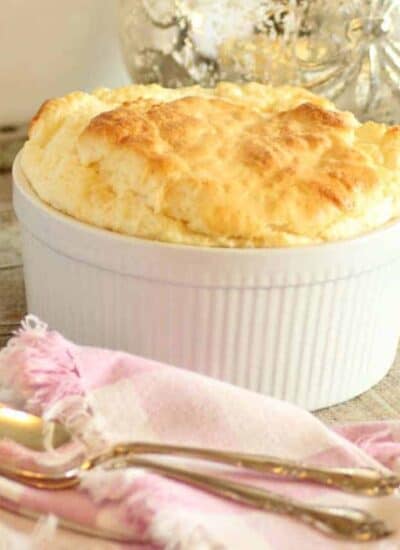
We are in week 13 now, only two more weeks to go and I am definitely going to have a void in my life when this is all over. I have so enjoyed doing our assignments. This week is the infamous souffle. Julia says, “the souffle is undoubtedly the egg at it’s most magnificent, the egg in it’s puffing power.” It surely is, what a magnificent thing to behold. You have only a few minutes to observe the souffle in it’s heights as when it starts to cool it starts to deflate. So this is something that needs to go from oven to table immediately. Julia uses a technique, that I watched on her DVD, using two spoons plunged into the middle and then you pull the souffle apart and serve.

You can add many things to a souffle like spinach, broccoli, seafood and salmon. We decided on lobster as the souffle seemed to be worthy of this seafood. It was out of this world fantastic!!!! We were all in epicurean heaven!!! This was a very memorable experience. Light and creamy and melting in your mouth. Come with us to explore this magical recipe, you will not be disappointed!!

2 Tbsp. finely grated Parmesan or other hard cheese
2 1/2 Tbsp. butter
3 Tbsp. flour
1 cup hot milk
1/2 tsp. paprika
fresh grating of nutmeg
1/2 tsp. salt
3 grinds of white pepper
4 egg yolks
5 egg whites
Pinch of cream of tartar
1/2 grated Gruyere cheese
Lobster tail
1/2 cup white wine

Butter a 7 1/2″ -8″ round souffle dish. Roll the grated Parmesan around the sides and bottom of dish. Have ready an aluminum collar that is 3″ above the dish and a straight pin to secure. Preheat the oven to 400F and set the rack to the lower third level.
Pour white wine into a small saucepan and bring to boiling. Place lobster tail in and poach for approximately 8 min. Let cool and remove meat and chop finely.

Melt the butter in a medium sized sauce pan and add the flour. Cook stirring constantly for 2 minutes. Do not brown. Remove from the heat and cool slightly. Pour in all the hot milk at once and whisk vigorously to blend. Return the saucepan to the heat and with a wooden spoon stir and let boil slowly for 3 min. The sauce will turn very thick. Remove from heat and whisk in the paprika, nutmeg, salt and pepper. One by one whisk in the egg yolks. Add cooked lobster.

In a separate bowl beat the egg whites to stiff shiny peaks. Scoop a quarter of the egg whites and stir into the egg yolk mixture. Turn the rest of the egg whites on top and gently fold in with a wooden spoon alternately adding sprinkles of the grated Gruyere cheese. Spoon mixture into the prepared dish and place the aluminum collar on and secure with the pin. Place in the oven. Reduce heat to 375F bake for 30-35 minute or until the souffle has puffed 2-3 inches and the top is nicely browned. You can slide a cake tester into the outer edge to make sure it is done.

Remove from the oven and carefully remove the collar. Bring to the table immediately and plunge two spoons into the center and pull the souffle apart. Serve onto individual plates. Lovely with a salad.

Print Friendly

Julia Child’s Provencal Tomatoes

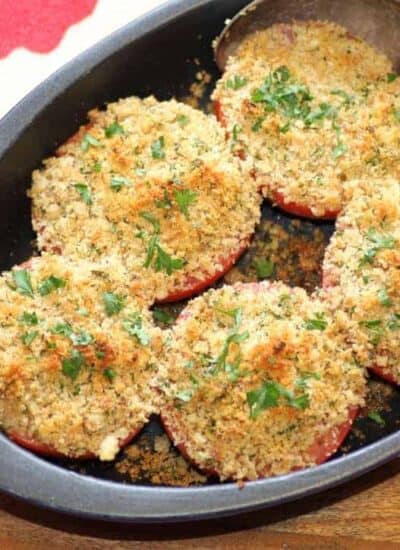
Here is our final installment this week for the third vegetable we were assigned. Ken is the official tomato stuffer in this house hold. He makes them many ways and we have loved them all over the years. I really liked this recipe of Julia’s. It was very easy and so very delicious. We have a little guest visiting us right now, Zack. A great friend for Amber, just like having a little brother. Anyway he looked at the tomato and said that he doesn’t like tomatoes. I told him to just try a bite and that was all it took the entire tomato was devoured, he loved it!!! I do make my own bread crumbs whenever I can and have them ready in the freezer. I use stale bread or bread crusts and whirl them in the food processor and then store them in a bag in the freezer. I just ran out of Herbes de Provence. We use this a lot when we are smoking poultry and it we just finished it on our last two smoked birds. It is not easy to find so I will have to locate some again when we are in a specialty store. I improvised by making my own blend using marjoram, thyme, crushed fennel seeds, powdered savory and basil. I added equal portions of all to add up to 1 tsp. It was perfect!!

3 Large firm ripe tomatoes
Salt and freshly ground pepper

For the Stuffing

1 cup bread crumbs, homemade preferably
2 Tbsp. minced shallots
1 tsp. dried Herbes de Provence
3 Tbsp. freshly grated Parmesan cheese
2 Tbsp. chopped fresh parsley
3 Tbsp. olive oil, plus more for drizzling

Set a rack in the upper level and preheat oven to 400F. Core the tomatoes and cut them in half crosswise. Over a bowl or the sink if you don’t wish to save the juice, gently squeeze each half to remove the seeds and juice. With your fingers clean the cavities of any clinging seeds. Arrange them in a shallow baking dish cut side up. If they don’t stand flat cut a small amount off the bottom of the tomato to that they will sit flat. Season with a sprinkling of salt and pepper.

Stir together the bread crumbs, shallots, Herbes de Provence, Parmesan cheese and parsley. Add 2-3 Tbsp. of olive oil to moisten the crumbs and toss to coat evenly. Spoon the stuffing on the tomatoes making sure that it goes down inside the tomatoes by pushing it into the cavities and then mound on top. Drizzle the tomatoes with olive oil. If making ahead you can cover and refrigerate at this point or bake for 20 min. until the tops are nicely browned and the tomatoes are hot but still keep their shape. Serve them hot in the baking dish or move them carefully to a platter.

Excerpted from Mastering the Art of French Cooking by Julia Child. Copyright © 1961 by Alfred A. Knopf. Reprinted with permission from the publisher Alfred A. Knopf, a division of Random House, Inc.

loving this crazy life

BWS tips button
 

Print Friendly

Julia Child’s Celery Root Remoulade

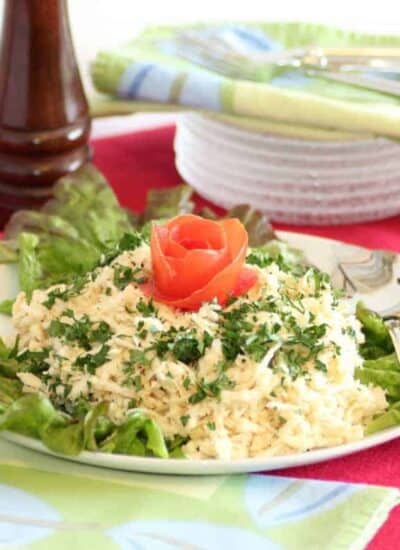
Here we are with our second installment of this week’s assignment from JC100. I have cooked with celery root quite a few times, mainly making a salad that my mom used to make which is delicious and I will share with you one day. It is a ugly vegetable that I bet not many have tackled because of it’s appearance and not quite knowing what to do with it. Julia writes, “Underneath the brown, wrinkled exterior of celery root there is white flesh with a bright celery flavor and crisp texture that, when finely shredded, makes a delicious slaw like salad.” Julia also goes on to say that you will need a good shredding device, like a mandolin, food processor with a grater attachment of a sharp box grater. Celery root is quite easy to work with and makes a pleasant salad that you may not have ever tried before. Julia suggests to make your own homemade mayonnaise for this recipe but when using only 2 Tbsp. I was honestly not going to go there. She did have two recipes, one with cooked egg and one using the food processor. I will try them at another time. My added extra touch was the tomato rose that she had suggested to go with the salad as a optional garnish.

1 1/4 lb. celery root
1/2 lemon for rubbing and for juice
1/2 tsp. salt
1 Tbsp. Dijon mustard
3 Tbsp. sour cream
2 Tbsp. mayonnaise, preferably homemade
1/4 tsp. freshly ground pepper

Optional garnishes
Boston lettuce leaves (I had red leaf lettuce on hand)
Chopped fresh parsley
Tomato rose (instructions to follow)
With a sharp knife slice off the ends of the celery root and then most of the brown peel. Trim the bits of brown remaining and slice the root in half. Remove the spongy area in the middle by cutting it out. Rub the pieces with the half lemon to prevent it from browning. Cut again in half for easier grating. I used a food processor with a grater attachment. Shred the root now in the machine. Transfer to a bowl and toss with 1 tsp. salt and juice squeezed from half the lemon. Let marinate for 30 min. but no longer than one hour.

For the dressing mix together the sour cream, mayonnaise, mustard and pepper. You may want to loosen it up with a little more lemon juice. Fold the dressing into the celery root. Cover with plastic wrap and refrigerate for one to two hours.

To make the tomato flower it may be helpful to watch one of many you tube instructional videos on how to make a flower but it is pretty easy. Take a small clean tomato and starting at the bottom make a large slice, now continue carefully working around the tomato turning it as you go, just like peeling an apple. Keep close to the skin not making it very thick until you come up to the stem. Slice it from the tomato and now curl the peel starting at the small core end and eventually ending with the large end and fold that onto itself. Turn the rose over and you are done.

Place the lettuce leaves on a plate and mound the salad up in the middle garnishing with the tomato rose and the chopped parsley.

Excerpted from Mastering the Art of French Cooking by Julia Child. Copyright © 1961 by Alfred A. Knopf. Reprinted with permission from the publisher Alfred A. Knopf, a division of Random House, Inc.

Print Friendly

Julia Child’s Asparagus with Hollandaise Sauce

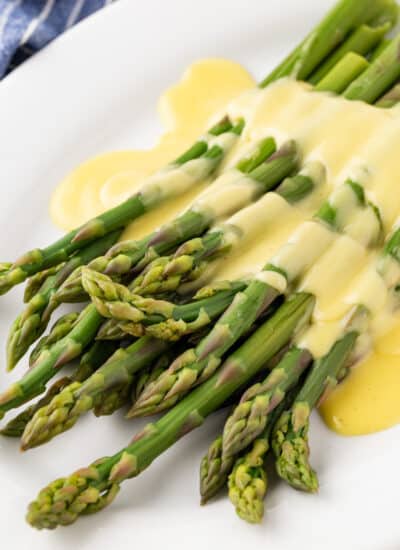
We are getting closer and closer to Julia’s birthday which is on August 15 and she would have been 100. Soon 100 restaurants will be joining in. Go to JC100 on Facebook to see who is all participating. We are now in week 12 of our celebration and for our assignment this week we have been given three different vegetables to make. I decided to do all three of course. I haven’t missed a recipe since we started. Instead of doing one massive post with all three recipes I will be doing it over three days. We were given 17 pages of recipes to go through so even if I wanted to do this over one day I would never be able to type that much. I started with the asparagus with Hollandaise sauce. I first watched her TV program that I have on DVD and then kind of incorporated both the recipes together. Wow, was this good and really very easy. No double boiler involved. It is all technique. This is the best Hollandaise sauce I have ever had. Can’t wait to try it on eggs benny and other dishes!! Ken thought it was a little too lemony but the rest of us thought it was perfect. For the asparagus Julia suggests to peel it, tie it in bundles, plunge it in boiling water and cook it until it is just tender. I used my method that I have done forever and you can see the asparagus is a gorgeous green. Trying to peel asparagus with a knife seemed to me to be too much work.

1 or 2 bunches of asparagus, firm, crisp stalks
3/4 cup butter, 1 Tbsp. cold the rest softened
3 eggs yolks
1 Tbsp. cold water
1 Tbsp. fresh lemon juice
Salt and white pepper

Beat the egg yolks in a small sauce pan until they become thick and sticky. Add the water, lemon juice and salt and beat for half a minute more. Add a Tbsp. of cold butter but don’t incorporate it in the eggs yet. Place the saucepan now over low heat. Now stir the egg yolk with a wire whisk until they slowly thicken into a smooth cream. If they thicken too much or become lumpy immediately plunge the bottom of the pan in cold water, beating the eggs to cool them. Then continue on the heat again beating until you can begin to see the bottom of the pan between strokes. Now start to incorporate the softened butter in dollops continuing to whisk constantly and moving the pan off and on the heat. When all the butter is incorporated season to taste with salt and white pepper. Remember that the Hollandaise sauce is served warm not hot. The saucepan can be kept in lukewarm water for about an hour. Whisking occasionally.

Break the end off the asparagus by bending them and letting them snap off where they are more tender. Discard ends. Wash well. In a large saute pan heat add water and salt and heat. Bring to a boil. Add asparagus and simmer covered for 4-5 min. until just tender. Immediately remove and serve with the Hollandaise sauce.

Excerpted from Mastering the Art of French Cooking by Julia Child. Copyright © 1961 by Alfred A. Knopf. Reprinted with permission from the publisher Alfred A. Knopf, a division of Random House, Inc.

Print Friendly

Julia Child’s Ratatouille

Here we are at week 11 of our JC100 celebration. Only 4 weeks left. Julia writes in her recipe, “Ratatouille perfumes the kitchen with the essence of Provence and is certainly one of the great Mediterranean dishes.” She was exactly right our home smelt so very good as I slowly and lovingly recreated this wonderful dish. I have made Ratatouille before but not Julia’s recipe. There is no going back now. This will be how I make it from now on. It takes a good few hours to get this recipe completed but it is so worth it. The nice part is that you could make the entire dish ahead of time and then just gently reheat it, even the day before. The flavours would just get better. Everyone that tried it couldn’t believe how much they liked it having not liked eggplant in the past. Ken who was a nonbeliever absolutely loved it. Ken has not like eggplant before as it can be bitter with the skin on and spongy when cooked. Well leave it to Julia to create the perfect Ratatouille. There was no bitter taste but the eggplant was sweet and done to perfection. Julia suggests that dish is best when it accompanies plain roast or broiled beef or lamb, pot-au-feu, or plain roast, broiled or sauteed chicken. Join us on the journey to the best Ratatouille you will ever eat!!

1 lb. eggplant
1 lb. zucchini
1 tsp. salt
4 Tbsp. good olive oil, more if needed
1/2 lb. thinly sliced yellow onion, about 1 1/2 cups
2 sliced green peppers, about 1 cup (I used about 1 1/2 cups)
2-3 Tbsp. olive oil
2 cloves mashed garlic (I used 4 cloves)
Salt and pepper to taste
1 lb. firm, ripe, red tomatoes, peeled, seeded, juiced (makes about 1 1/2 cups of pulp)
3 Tbsp. parsley

Peel the eggplant and cut into lengthwise slices 3/8″ thick, about 3 inches long and 1 inch wide. Wash the zucchini and slice off the ends. Cut the zucchini into the same size as the eggplant. Place the vegetables in a large bowl and sprinkle with the tsp. of salt, I used about 1 1/2 tsp. Toss and let stand for 30 min. Drain. Lay out paper towels and dry each slice on both sides.

In a large skillet saute the eggplant first in 1 Tbsp. hot olive oil adding more as needed, in a single layer and in batches. Cook for about 1 minute then turn over so that each side is lightly browned. Remove to a side dish lined with paper towels. Repeat with the zucchini.

In the same skillet, cook the onions and peppers slowly in the 2-3 Tbsp. olive oil for about 10 minutes or until tender but not browned. Stir in the garlic and season to taste with salt and pepper.

Slice the tomato pulp into 3/8″ strips. Lay then over top of the onions and peppers. Season with salt and pepper and cover the skillet. Cook on low heat for 5 min. or until the tomatoes have started to render their juices. Uncover and baste the tomatoes with the juice and then raise the heat and boil for several minutes until the juice has almost entirely evaporated.

In a 2 1/2 quart fireproof casserole place one third of the tomato mixture in the bottom. Sprinkle on 1 Tbsp. of parsley. Arrange half the eggplant/zucchini mixture on top. Then add half of the remaining tomatoes and parsley. Put in the rest of the eggplant and zucchini and finish with the remaining tomatoes and parsley.

Cover the casserole and simmer over low heat for about 10 min. Uncover and tip the casserole to get some of the rendered juices and baste. Add salt and pepper if needed. Raise the heat up slightly and cook uncovered for about 15 min. more, basting several times, until the juices have evaporated leaving about a spoonful or two of olive oil. Be careful with the heat, do not let the bottom of the casserole burn.

You can now set this aside or refrigerate overnight. Reheat slowly at serving time or serve cold. This would be fabulous on a crusty bread sandwich with cold meats.

Excerpted from Mastering the Art of French Cooking by Julia Child. Copyright © 1961 by Alfred A. Knopf. Reprinted with permission from the publisher Alfred A. Knopf, a division of Random House, Inc.


Print Friendly

Julia Child’s Bouillabaisse

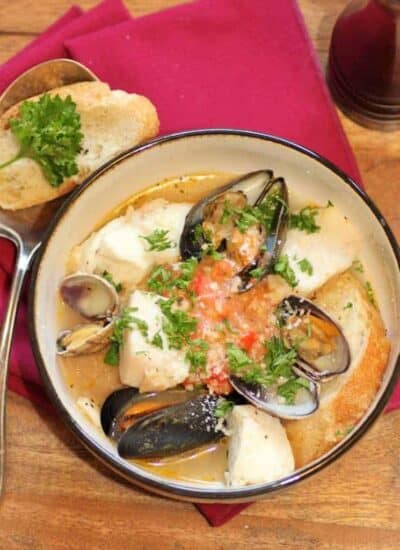
We are on week 10 now. Getting close to Julia’s 100th birthday celebration!! Only 5 more weeks to go. Her birthday is on August 15 and she would have turned 100 then if she was still with us. She had such great wit, talent and knowledge. Very quick on her feet since she did not have all the editing and technology of today for her cooking shows. Again I enjoyed watching Bouillabaisse a la Marseillaise on my DVDs. She just loves hacking at a fish with a big knife. Amazing!! Anyway, we and I mean we all made this Bouillabaisse the other night. I was busy trying to set up a few other things and Ken and Amber jumped in for me and I thank them very much!!! It turned out fabulous!! I had the advantage of some purchased fish stock that I had in the freezer. Keep you eye open for it at your local fish market. You just might luck out. Easier than trying to find the fish carcasses I would think. You are to use a portion of gelatinous fish such as halibut, eel and some of the firmer fleshed flounder. You can add a variety of fish and I have included a list below, some I have never heard of!! You can also add things like lobster and crab but Julia does say that this was a fisherman’s stew made from the unsaleable fish of the day. It does not need to be fancy. With watching, reading and learning this is what I have come up with for Julia’s Bouillabaisse.

Serves 4.

1.5 L fish stock
500 ml. water
1 cup minced onion
1/3 cup olive oil
4 cloves mashed garlic
1 large ripe red tomato
6 parsley sprigs
1/8 tsp. fennel
A 2 inch piece of dried orange peel or 1/2 tsp. dried orange peel
1 bay leaf
1 tsp. basil
2 big pinches of saffron
Freshly ground pepper
1 Tbsp. Kosher salt
1 halibut steak
1 large fillet of red snapper, cut into manageable pieces
3 large scallops, sliced in half
12 mussels
12 clams
Rounds of hard French Bread toasted
1/2 cup Parmesan cheese, finely grated
Parsely, chopped for garnish

Rouille

1/4 cup chopped red bell pepper
1 small Serrano pepper, seeded
1 medium peeled potato, cooked in the soup
4 cloves mashed garlic
1 tsp. basil or thyme
4 Tbsp. fruity olive oil
Salt and pepper

Alternative fish you can use are:

Rock, Calico or Sea Bass
Cod or Lingcod
Flounder
Grouper
Grunt
Haddock
Hake or Whiting
Halibut
Lemon Sole
Perch
Pollock or Boston Bluefish
Porgy or Scup
Redfish or Red Drum
Scrod
Fresh water trout; Sea Trout or Weakfish
Shellfish-clams, mussels, crab or lobster

Simmer the red pepper for several minutes in salted water and drain. Simmer the Serrano in boiled water until tender. Now place the red pepper, Serrano pepper, potato, garlic and basil in a bowl or mortar and pound for several minutes until you form a paste. Drop by drop add in the olive oil as for making a mayonnaise and beat. Season to taste with salt and pepper. Just before serving loosen up the sauce with 2-3 Tbsp. of hot soup.

Saute the onion in the olive oil until tender in a large saucepan. Stir in the garlic and tomatoes. Raise the heat to moderate and cook for 5 min. more. Add the fish stock and water. Then add the parsley sprigs, bay leaf, basil, saffron, pepper and salt. Simmer for 30-40 min. Strain the soup, pressing out the juices from the ingredients. Correct seasoning. Drain the soup now back into the pot and place in your larger pieces of fish like the halibut steak. Simmer for 5 min. Now add the red snapper, scallops, clams and mussels and cook another 5-7 min. until the mussels and clams open. Place rounds of the toasted bread in the bottom of each soup bowl. Pour the soup into each soup bowl dividing the fish and shellfish amongst the bowls. Pass around the rouille, cheese and parsley.

Excerpted from Mastering the Art of French Cooking by Julia Child. Copyright © 1961 by Alfred A. Knopf. Reprinted with permission from the publisher Alfred A. Knopf, a division of Random House, Inc.

This has been included in the Manic Monday Party

Print Friendly

Julia Child’s Charlotte Chantilly, Aux Framboises

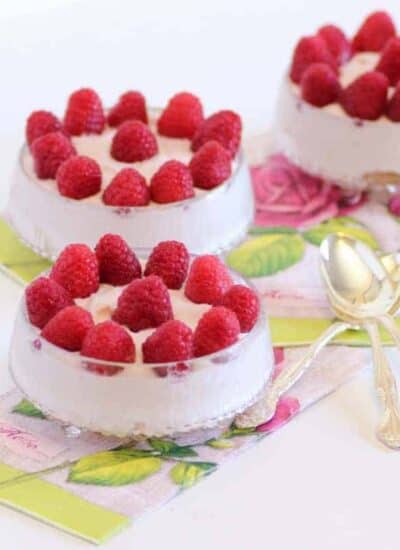
Welcome to week 9 of our JC100 celebration. This week we are doing a Charlotte. Traditionally you would mold this dessert but trying to find a Charlotte mold in Calgary, AB I soon found out is virtually impossible. If the kitchen stores understood what I was asking for or not they didn’t have one. So, Julia also says that you can serve this in a serving bowl or dessert cups. I opted for the dessert cups. I still made the ladyfingers from scratch but you can make it easy on yourself and buy them. I actually whipped the egg whites by hand as I have never done that before and because I don’t have a copper bowl Julia suggested to add a pinch of cream of tartar to the egg whites. You really get a good workout whipping those whites. I think my fingers were not quite crisp enough but do absolutely fine in the bottom of the dish. This is a bright and sunny dessert that is light as a cloud. Perfect for a summer day!! I enjoyed watching my DVD as I always do seeing her work her magic. She made a Charlotte Malakoff au Chocolat which reminds me of her mousse. You can fill a Charlotte with many different filling. I went to the store wanting to do a strawberry one but left with raspberries as they were so beautiful. It makes me miss my raspberry patch I had at our last house. Anyway, I hope you enjoy this recipe as much as we did!!

Ladyfingers

1 Tbsp. softened butter
Flour

Preheat oven to 300F. Prepare two 12 x 24″ baking sheets by buttering lightly and then dusting with flour. Knock off the excess. Set aside.

1/2 cup sugar
3 egg yolks
1 tsp. vanilla
3 egg whites
Pinch of salt
1 Tbsp. sugar
1/2 cup flour
1/2 cup powdered sugar

With an electric mixer fitted with a wire whisk gradually add the sugar to the egg yolks and the vanilla. Continue beating until the mixture is pale yellow, thick and forms a ribbon. This will take a few minutes.

Beat the egg whites and salt together in a separate bowl until soft peaks are formed. Sprinkle in the sugar and continue to beat until stiff peaks are formed. Scoop a quarter of the egg whites into the egg yolk mixture with a quarter of the flour. Fold in with a spatula. Continue adding another quarter of the egg whites and a quarter of the flour until all is used up and just incorporated leaving your batter light and fluffy. Now scoop the batter into a pastry bag fitted round opening 1/2″ in diameter. Pipe the fingers out slowly making them 4″ long and 1 1/2″ wide. Sprinkle on the icing sugar. If there is too much you can turn the pan over and the excess will fall off but the fingers will stay on the tray. Try it, it really works!! Bake in the middle of the oven until very pale brown underneath their sugar coating for about 20 min.

These can be served on their own or used in the dessert to follow.

Charlotte Chantilly, Aux Framboises

1 1/2 pints fresh raspberries
2/3 cup berry sugar
8 egg yolks
2 1/2 cups heavy whipping cream

Wash and check over the raspberries. Run them through a fine sieve and into a bowl measuring out 1 1/4 cups of puree. Chill.

Beat the sugar into the egg yolks with a wire attachment on a electric mixer and continue beating until mixture is pale yellow and falls back on itself forming a slowly dissolving ribbon. Now place the bowl over not quite simmering water and and beat until the mixture had thickened into a cream and becomes too hot for your finger. Remove the bowl and set in now in a bowl of iced water and continue to beat until the mixture is cold again forming a slowly dissolving ribbon. Set aside and beat the cream until stiff peaks form. Fold the chilled raspberry puree into the egg yolk mixture and then fold in the whipped cream. Place the ladyfingers into the bottom of a individually serving dish and top with the raspberry filing. Refrigerate until set and completely cold. Decorate with the remaining berries.

Excerpted from Mastering the Art of French Cooking by Julia Child. Copyright © 1961 by Alfred A. Knopf. Reprinted with permission from the publisher Alfred A. Knopf, a division of Random House, Inc.

Print Friendly

Julia Child’s Roast Chicken

It is week 8 into our celebration of JC100 and we are learning how to roast a chicken to perfection. I honestly think this was the best chicken I have ever made. Moist and juicy and full of flavour. You probably thought you made a pretty good chicken already but if you follow Julia’s techniques you will make an even better roast chicken. I watched Julia last night on my DVD to see if there were any thing else I was missing. She talks a lot about the much enjoyed bird. From first washing it well, to checking it over for unwanted feathers, to trimming the nubs off the wings and removing the wish bone for easier carving and finally trussing it securely. On her show she has an open counter top rotisserie and an oven one. Two things you don’t see that much of today. She also added strips of bacon to the chicken when she was trussing it up. Doing the rotisserie method you would cook the bird twice as long but she ended up with a gorgeously browned chicken. Upon studying the DVD, my assignment and a few recipes this is what I came up with and it was fantastic!!!
I love that I am continually learning on this journey.

For The Roast Chicken

3-4 lb. chicken
1/2 onion, sliced
Handful of celery leaves
2 Tbsp. butter
Salt and pepper
Herbs de Provence
2 Tbsp. olive oil
1 onion, chopped
2 carrots, chopped

Sauce

1 Tbsp. pan drippings
1 cup chicken stock
1 cup beef stock
2 tsp. fresh thyme leaves
2 Tbsp. cornstarch
4 Tbsp. port
Salt and pepper

Mashed potatoes
Green Beans

Preheat oven to 425F. Remove giblets from inside of the chicken if necessary. Wash the chicken well inside and out and dry well. Salt and pepper the cavity and place in the 1/2 sliced onion and the celery leaves. Fold the wings under the chicken. Julia says to fold them “akimbo”, which is I am sure what she meant. Tie drumstick ends together. Rub the outside of the chicken with the butter and sprinkle on the salt and Herbs de Provence. Oil a cast iron pan or small roasting pan with a V shaped rack with the olive oil. Place chicken in the preheated oven and baste every 10 min. for 30 min. Scatter the chopped onions and carrots around the chicken and reduce the oven to 350F. Continue to baste every 10 min. now including the vegetables. The chicken will take an hour and 10 to 20 min. to reach an internal temperature of 170F. Remove chicken from the pan and let it rest on a cutting board while you make the sauce.

Remove vegetables from the pan and all the drippings but 1 Tbsp. Heat the pan on the stove and add the chicken and beef stock. Bring up to a rapid boil and reduce slightly. Add the fresh thyme leaves. Stir the cornstarch and port wine together and add to the sauce stirring constantly. Adjust seasoning with salt and pepper. If too thick adjust with more stock.

Slice chicken and serve over mashed potatoes with cooked green beans (or veggie of choice) and the roasted carrots and onions. Pour the sauce over and serve immediately. Gorgeous!!

Excerpted from Julia’s Kitchen Wisdom by Julia Child. Copyright © 2000 by Julia Child. Reprinted with permission from the publisher Alfred A. Knopf, a division of Random House, Inc.

Print Friendly